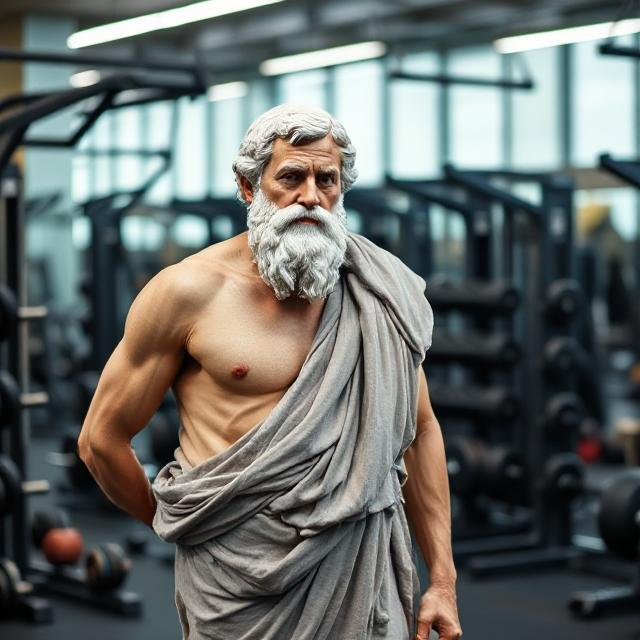
The Cultivation of Character: Virtue Ethics and the Bodybuilder
The pursuit of physical excellence through bodybuilding and resistance training, often perceived as a purely aesthetic endeavor, can be understood as a profound exercise in character development. While the outward goal may be a sculpted physique, the process itself cultivates a range of virtues, echoing Aristotle’s exploration of aretē (excellence or virtue) in his Nicomachean Ethics. This essay will examine the virtues inherent in the bodybuilding lifestyle, exploring how they are developed through habituation, and how they function as moral qualities that guide behavior, ultimately demonstrating that the pursuit of physical perfection can be a powerful catalyst for ethical growth.
Aristotle defined virtues as character traits that enable individuals to flourish, both individually and within their communities. They are not innate but rather acquired through practice and habituation, representing a “golden mean” between two extremes – a deficiency and an excess. For example, courage is the mean between cowardice (deficiency) and recklessness (excess). Virtues are not merely feelings or inclinations but rather settled dispositions that guide our actions, choices, and emotional responses. They are moral qualities because they contribute to eudaimonia – often translated as “flourishing” or “living well” – which Aristotle considered the ultimate goal of human life. We recognize virtues through observing individuals who consistently act in accordance with reason and demonstrate excellence in their actions. These individuals, whom Aristotle called “virtuous,” serve as exemplars, guiding us towards the mean.
The development of virtue, according to Aristotle, is a process of habituation. We become virtuous by repeatedly performing virtuous actions, gradually internalizing these behaviors until they become second nature. Just as a musician becomes skilled through practice, we become virtuous by consistently choosing and acting in accordance with the mean. This process requires conscious effort and self-discipline, as we must initially struggle against our natural inclinations towards the extremes. This is where the connection to bodybuilding becomes clear.
The bodybuilding journey, with its rigorous demands and consistent effort, provides a fertile ground for the cultivation of virtues. Consider the virtue of discipline. The bodybuilder must adhere to a strict training regimen, often involving multiple workouts per week, each requiring intense focus and effort. They must also maintain a carefully controlled diet, often involving meticulous meal planning and preparation. This consistent adherence to a demanding lifestyle cultivates discipline, not only in the gym and at the dinner table but also in other areas of life. The ability to resist immediate gratification in favor of long-term goals is a hallmark of discipline, and it is a virtue that extends far beyond the realm of physical training.

Another key virtue cultivated through bodybuilding is perseverance. Muscle growth is not a linear process. It involves plateaus, setbacks, and injuries. The bodybuilder must learn to push through these challenges, to remain committed to their goals even when progress seems slow or nonexistent. This cultivates perseverance, the ability to persist in the face of adversity. This virtue is essential not only for achieving physical goals but also for overcoming obstacles in other aspects of life, from academic pursuits to professional challenges.
Patience is also essential. Building a physique takes time and dedication. There are no shortcuts, and the bodybuilder must learn to embrace the process, to appreciate the small victories along the way. This cultivates patience, the ability to endure hardship or delay gratification without complaint. In a world that often emphasizes instant results, the virtue of patience, honed through the slow and steady progress of bodybuilding, is a valuable asset.
Furthermore, bodybuilding can foster temperance. While it might seem counterintuitive, given the focus on physical development, temperance – the mean between self-indulgence and asceticism – is crucial. The bodybuilder must learn to balance their desire for physical perfection with other important aspects of life, such as relationships, work, and intellectual pursuits. They must also avoid the excesses that can lead to injury or burnout, such as overtraining or the reckless use of performance-enhancing drugs. This cultivates temperance, the ability to moderate one’s desires and impulses, ensuring a balanced and healthy lifestyle.
It is important to note that the virtues cultivated through bodybuilding are not limited to those directly related to physical training. The process can also foster virtues such as courage (to push oneself beyond perceived limits), humility (to acknowledge one’s limitations and the need for continuous improvement), and even compassion (for others who are struggling with their own fitness journeys). The shared experience of overcoming challenges and striving for self-improvement can create a sense of camaraderie among bodybuilders, fostering a supportive and encouraging environment.
However, it is crucial to acknowledge that bodybuilding, like any pursuit, can be taken to extremes. The focus on physical appearance can become obsessive, leading to unhealthy behaviors such as disordered eating or the reckless abuse of performance-enhancing drugs. This highlights the importance of the “golden mean.” Just as courage can become recklessness, the pursuit of physical excellence can become self-destructive if it is not tempered by reason and moderation. The virtuous bodybuilder must strive for balance, ensuring that their pursuit of physical development does not come at the expense of their physical or mental health.
The shadow side of the pursuit of physical excellence in bodybuilding lies in the potential for vanity to take root. While a healthy sense of self-esteem can be a positive motivator, vanity, as a vice, represents an excessive and unwarranted preoccupation with one’s physical appearance. It manifests as an inordinate desire for admiration and praise, often coupled with a distorted perception of one’s own physique.
The bodybuilder consumed by vanity may prioritize external validation over genuine self-improvement, constantly seeking the approval of others rather than focusing on the intrinsic rewards of training. This can lead to a range of detrimental behaviors, from obsessive self-comparison and an unhealthy fixation on perceived flaws, to the neglect of other important aspects of life, such as relationships, intellectual pursuits, and personal growth. In the context of Aristotle’s ethics, vanity represents a deficiency in humility and a lack of balance. It is a distortion of the healthy pursuit of physical development, transforming it from a means of self-improvement into an end in itself. The virtuous bodybuilder, in contrast, cultivates a sense of self-worth that is grounded in internal values rather than external validation, recognizing that true excellence lies not just in physical appearance, but in the cultivation of character and the pursuit of a balanced and fulfilling life.
In conclusion, the virtues cultivated through bodybuilding are not merely instrumental to achieving physical goals; they are intrinsic to the process itself. The discipline, perseverance, patience, and temperance required to build a physique are virtues that extend far beyond the gym, shaping character and guiding behavior in all aspects of life. By understanding the connection between physical training and ethical development, we can appreciate the profound potential of bodybuilding as a means of cultivating not just a strong body, but also a virtuous character. It is through the consistent practice of virtuous actions, honed in the crucible of physical training, that the bodybuilder can truly achieve eudaimonia – a life well-lived, marked by excellence in both body and character.